District Vice-Mayors (Social Affairs) get trained on Strengthening Social Protection Project (SSPP)
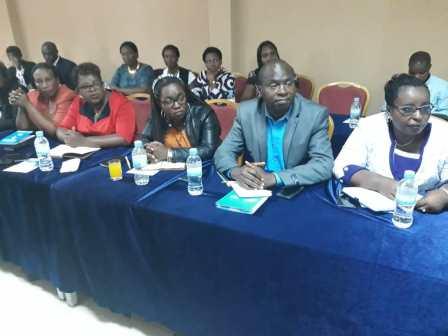
KIGALI - Today on 19th October 2018 at Lemigo Hotel, District Vice Mayors (in charge of Social Affairs) have got refresher training on aspects of Social Protection, and updated guidelines on Vision 2020 Umurenge Programme (VUP) and livelihood programmes, with focus on Strengthening Social Protection Project, a World Bank funded project starting with FY 2018/2019 . Organized by LODA, the objective of the training is to ensure that Vice Mayors understand the principles of social protection, the Government policy and the design of VUP and Ubudehe programmes, to reinforce current policy and practice and will provide an opportunity to develop financial management skills within the programme. This will improve compliance with routine monitoring and effectiveness of VUP and Ubudehe programmes implementation.
While officiating this training session, Mrs. NKUNDA Laetitia, Director General of LODA, lauded efforts provided by District managers through the implementation of social protection programmes throughout the last FY 2017/2018, and urged them to keep this momentum to better serve citizens across this FY 2018/2019. She pointed out that this kind of technical training is meant to enable District decision makers to thoroughly understand the requirements of the World Bank newly funded project “Strengthening Social Protection Project” (SSPP) so as to efficiently and effectively fulfill their duties. The Director General reiterated the need for Social Protection Sector Capacity Building: “Vice-Mayors in charge of Social Affairs should understand enough about social protection to take well-informed management decisions, but do not need to be technical experts”, she said.
In her detailed exposé on SSPP, Mrs. UWIMBABAZI Esperance, Director of Livelihood Unit at LODA, revealed that thanks to the WB funding to improve the implementation of VUP, there will be:
Back
- Continuation of Direct Support (DS) grants to all eligible populations nationwide and expansion of eligibility criteria to include households with persons with a disability;
- Continuation of Classic Public Works (cPW) from 128,000 households (in 240 sectors) currently to approximately 141,361 (in 270 sectors);
- Major extension of gender and child‐sensitive Classic Public Works (ePW) model to reach 75,000 households (in 300 sectors) by the end of the project.