Kigali - Today on 9th November 2018 at Hotel Villa Portofino, Nyarutarama, there was held a breakfast meeting gathering around 30 senior representatives of key International Non-Governmental Organizations (INGOs) active in Rwanda to share progress in the development and implementation of the latest Social Protection Sector Strategic Plan (2018-2024) and associated Multi-sectoral Action Plan for the Eradication of Extreme Poverty. Convened by the Ministry of Local Government (MINALOC) in collaboration with the Local Administrative Entities Development Agency (LODA), the meeting was chaired by Hon. Minister Professor SHYAKA Anastase.
The purpose of the meeting is to commence a process of dialogue between the Government of Rwanda and key national and international NGOs on how to strengthen their strategic partnership in support of Rwanda’s objective of eradicating extreme poverty by 2024 as suggests the target of the National Strategy Transformation (NST1). In more specific terms, the meeting was intended:
- to increase NGOs awareness and understanding of the Government’s Social Protection Sector Strategic Plan and, specifically, the proposed multi-sectoral approach to accelerating the eradication of extreme poverty;
- to solicit comments from NGOs on the approach being employed with a view to strengthening the effectiveness of the strategy;
- to share findings from the household profiling exercise conducted in 17 districts;
- to explore the opportunities and challenges associated with harmonizing NGO programming with the multi-sectoral action plan;
- to identify an appropriate mechanism to facilitate planning, coordination and monitoring for all stakeholders to share experience and lessons for good practices; and
- to share lessons from existing partnerships between the government and CSOs/NGOs in the social protection sector.
In his remarks to Country Representatives of national and international NGOs, Hon. Minister Professor SHYAKA Anastase said: “
The Government of Rwanda has done a lot to alleviate extreme poverty, but we still need to do more and partnership is key to more achievements. Eradication of extreme poverty is one major focus of the Rwandan Government”. Speaking to the media, Minister SHYAKA revealed that this event was convened to meet with international Non-Government Organizations given their relevant (but scattered) social development action and considerable financial support to vulnerable people. “
We wish to join our efforts, and harmonize our socio-economic interventions with more focus to people of the lowest Ubudehe category identified from 17 Districts living in extreme poverty and high stunting rate”, he added on.
As a flashback to what has been achieved, Rwanda has made significant progress in the eradication of extreme poverty. However, according to the Poverty Trend Analysis Report of 2016 by National Institute of Statistics of Rwanda, “Whereas the progress is commendable, it must be remembered that 39.1% of the population still lives in poverty, including 16.3% who live in extreme poverty
[1]”. Further, data from Household Profiling conducted by LODA in 2017 indicate that a large number of households remaining in extreme poverty include over 413,749 households from the lowest Ubudehe category. Faced with this challenge, the target of the commencing National Strategy for Transformation (NST1) requires multiple efforts towards the eradication of extreme poverty by 2024, thus reaching its overarching goal for the Social Transformation Pillar which is to “Develop Rwandans into a capable and skilled people with quality standards of living and a stable and secure society”.
In his exposé on the envisaged multi-sectorial plan to accelerate the eradication of poverty, Mr. SIBOMANA Saidi, Division Manager in charge of Local Development Planning, Monitoring & Evaluation at LODA, stated that “t
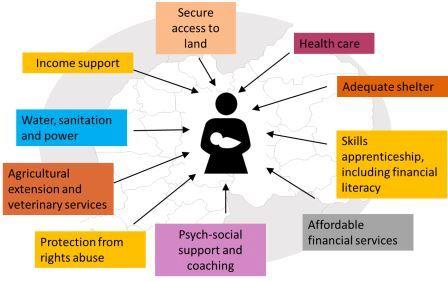
he Government of Rwanda intends to converge a holistic household centered support to 154,000 families in 17 priority districts to relive them from extreme poverty and high stunting. The ultimate strategic solution to this high ambition lies into joining efforts from Government, Non-Government organizations, the civil society and the private sector, while harmonizing planning and targeting of beneficiaries and strengthening partnership”.
Given the need to focus the limited resources available to achieve tangible impacts, MINALOC has selected 17 priority districts. These include the 7 poorest districts (Burera, Gicumbi, Gisagara, Nyaruguru, Ngororero, Nyamasheke and Rutsiro) plus the 10 districts with the highest stunting rates (Bugesera, Kayonza, Gakenke, Huye, Nyamagabe, Ruhango, Karongi, Nyabihu, Rubavu, Rusizi).
Under the supervision of MINALOC, LODA is a government agency mandated to implement local economic and community development policies and strategies, social protection and poverty reduction programs. Since 2008, LODA spearheads the implementation of Vision 2020 Umurenge Programme (VUP) in components of “Direct Support”, Public Works” and “Financial Services” to the attention of the most vulnerable households. In addition, another initiative known as the Minimum Package for Graduation (MPG) consisting of asset transfers was introduced since FY 2015/2016.